Buna

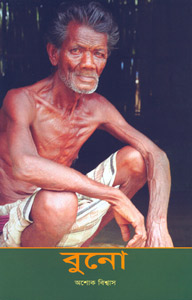
Buna

Survey of various ethnic communities and a description of their lifestyle, beliefs, social system etc.
2008, Bangla, 73 pages, Paperback  | Tk.150 / US$10

Buna is not just a single community, it is a conglomeration of different ethnic communities who live scattered in different parts of the country and are separated from their main bodies. The identity ‘Buna’ is imposed by majority Bangalis on those small communities who come from among Oraon, Bhuiyan, Mundari Pahan, Kurmi, Mahato, Lohar or Karmaker, Munda, Santal, Mahali, Bagdi, Bhumij etc. Buna is a derogatory term in Bangla.

Dependable statistical accounts on the Buna—their population and habitat among others—are difficult to find. According to the government population census of 1991, some 7,421 Buna people live only in Naogaon District. However, field investigation shows that there are 10 to 12 thousand people known as Buna or Sarder, who live in greater Jessore, Faridpur, Kushtia, Satkhira and Manikgonj districts. The identities of these communities are fading out behind the imposed identities like Buna, Banua or Sarder. The book, ‘Buna’ is an effort to introduce this people and provide dependable accounts on them.

Society for Environment and Human Development (SEHD) has published this book in the trail of its work on promotion of cultural rights and identities of different small communities. SEHD commissioned Dr. Ashok Biswas to do this work.

The writer visited the Buna inhabited areas and closely observed their lifestyle and their socio-cultural activities. He also conducted a survey in several villages of 12 districts of the country, where the Buna communities live. The survey does a mapping on their population, professions, education, economic activities, ownership of land and other resources, etc. The author has compiled information and statistics that come from his observation, investigation and survey. The book also describes the population, clothing, locality, home, kinship, social system and social division, marriage, norms and values, belief, religious rituals, etc. of the Bunas.

A significant portion of the book deals with the languagesMundari, Sadri and Santal— the Bunas speak. It describes the phonetics and syntax of Mundari language, guided by ‘Bangala Bhashar Itibrittyo’, authored by eminent linguist Dr. Muhammad Shahidullah. The book also contains a list of Sadri words.

Another focus of the book is on the literature of the Buna communities. It presents the current socio-economic condition of these small communities, which is a tough task as they live scattered. The book will be a useful reference to researchers as well as different types of readers.

Publication Details

Published: 2008
Language: Bangla
Paperback: 73 pages
Prepared by: Dr. Ashok Biswas
Price: Tk.150 / US$10
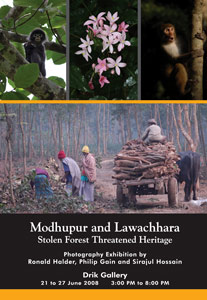
Modhupur and Lawachhara: Stolen Forest Threatened Heritage – Exhibition

Modhupur and Lawachhara: Stolen Forest Threatened Heritage – Exhibition

A photography exhibition which documents the state of Modhupur and Lawachhara forests and the people who live there.
2008, Catalogue English | Tk.50 / US$2

The photography exhibition Modhupur and Lawachhara: Stolen Forest Threatened Heritage shows the perilous state of the Modhupur and Lawachhara forests and the people who live there. Due to commercial interests, social forestry and plantations, both the forests and the way of life of the indigenous people of these areas have been encroached upon leaving them in a dangerous and vulnerable state.

Exhibition Details

Exhibition: 2008
Catalogue: English
Photographers: Ronald Halder, Philip Gain, Sirajul Hossain
Price: Tk.50 / US$2

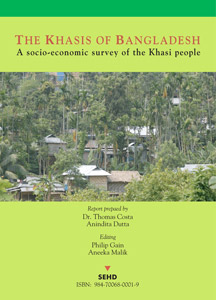
The Khasis of Bangladesh: A Socio-economic Survey

The Khasis of Bangladesh: A Socio-economic Survey

A socio-economic survey of the Khasis, their present status, population, social system, education, livelihood, etc.
2007, English, 60 pages, Paperback | Tk.150 / US$5

The Khasis are believed to be one of the indigenous groups who started to populate the Indian sub-continent ten to twenty thousand years ago. With the greater number of them living in India, this matrilineal ethnic group resides mainly in 11 Upazilas of the greater Sylhet District in the Northeastern region of Bangladesh.

According to the government census of 1991, the Khasi population in Bangladesh is 12,973. However, a great deal of controversy exists over this number. The existing accounts of different sources show a discrepancy as well.

It is in this context that the Society for Environment and Human Development (SEHD) conducted a socio-economic survey of the Khasi people from October 2005 to March 2006. The outcome is the report—The Khasis of Bangladesh: A socio-economic survey of the Khasi people.

The villages that the Khasis live in are called punjis. These punjis are normally located on the hillocks. A punji is an attractive destination for anyone taking interest in this unique indigenous community. There are 85 Khasi punjis in Bangladesh. SEHD wanted to cover all of them in its survey. However, it was possible to carry out the survey in 60 punjis. The basic information of the remaining 25 was collected and is provided in the report.

SEHD conducted the survey with the involvement and cooperation of Greater Sylhet Indigenous People’s Forum (GSIPF). The report presents a brief history of the Khasi people and important information on their present status, population, social system, education, livelihood, etc.

A write-up on Lyngngam (also spelt Lyngam), a small section of the Khasis, is appended with the main report. The Lyngngams live in ten villages of Kalmakanda Thana in Netrokona District. Their culture has a great deal of similarity with that of the Garos. The Garos call them Megam. There is no mention of Lyngngam in the population census.

The 60-page survey report also contains photographs, maps, and list of all Khasi punjis and basic information on the punjis. The report is expected to be beneficial to anyone interested to know the Khasis. The report also brings significant tips for the researchers who may home deep interest in the Khasi community.

Publication Details

Published: 2007
Language: English
Paperback: 60 pages
Prepared By: Dr. Thomas Costa and Anindita Dutta
Price: Tk.150 / US$5

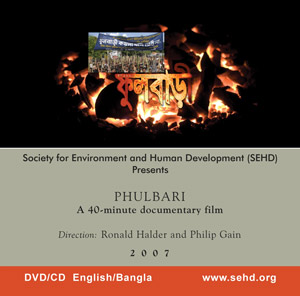
Phulbari – Documentary

Phulbari – Documentary

A documentary film on the social, environmental and economic issues of the proposed Phulbari open-cast mine.
2007, English and Bangla, 45 mins – DVD Tk.200 / US$10, CD Tk.100 / US$5

Phulbari, a 45-minute film documents facts about grassroots revolt in Phulbari against open-cast mining and explains complex social, environmental and economic issues involved with coal and its extraction strategies. In energy-poor Bangladesh coal is said to be an important resource that has put Bangladesh to the test. The film is an eye-opener to anyone interested in energy security in Bangladesh.

Publication Details

Published: 2007
Language: English and Bangla
Length: 34 minutes
Director: Ronald Halder and Philip Gain
DVD: Tk.200 / US$10
CD: Tk.100 / US$5

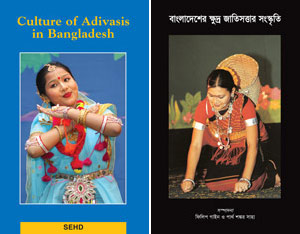
Culture of Adivasis in Bangladesh

Culture of Adivasis in Bangladesh

The cultural movement of the Adivasis of Bangladesh, their languages, politics and their influence on the majority.
2008, English, 149 pages, Paperback | Tk.300 / US$10 | 2007, Bangla (Bangladesher Khudra Jatishattar Sangskriti), 158 pages, Paperback | Tk.200 / US$10

“This book may be called a window of Adivasi culture through which we can see different faces of cultures of Adivasis and proudly say, cultural diversity is our pride.” The editors of the book Culture of ethnic communities of Bangladesh (Bangladesher Khudra Jatishattar Sangskriti) say this in the prelude of the book. Bangladesh really can take pride in its diverse and colorful culture. Different ethnic communities who live in different parts of the country make Bangladesh’s culture more colorful and lively; this is what the book has to say to its readers.

This book compiles diverse thoughts, analyses and facts that have emerged from SEHD’s work on culture with the ethnic communities. It contains ten write-ups of different authors that deal with the cultural world of the Adivasis; languages of the Adivasis and how they contribute to nurture, enhance and enrich Bangla, the language of the majority; the political and cultural movement of Adivasis; and a glimpse into Adivasi cultural riches of select communities.

A good number of images used with different sections, not only enrich the book, each image portrays the cultural riches of a different ethnic community.

Culture of ethnic communities of Bangladesh (Bangladesher Khudra Jatishattar Sangskriti) is the outcome of years of hard work. It is indeed, a gift to the readers.

Publication Details

Published: 2007
Language: Bangla
Paperback: 158 pages
Editor: Philip Gain and Partha Shankar Saha
Price: Tk.200 / US$10

Published: 2008
Language: English
Paperback: 149 pages
Editor: Philip Gain
Price: Tk.300 / US$10