

Vivienne Westwood and Marie Claire supporting forest people in Bangladesh

Vivienne Westwood and Marie Claire supporting forest people in Bangladesh

International designer Vivienne Westwood and international fashion magazine Marie Claire have joined forces to highlight the issue of deforestation. This global collaboration will combine the sale of the T-shirt dress with a special Rainforest editorial section in Marie Claire. Proceeds from the sale of the T-shirt dress will support the forest people in Bangladesh through SEHD activities.

People tree dressFor the first time ever, an international designer (Vivienne Westwood) and an international fashion magazine (Marie Claire) have joined forces, to launch an exciting global project that both drives awareness of deforestation and influences the current trend of up-cycling your clothes.

In Vivienne’s words ‘Buy less, choose well’.

Rainforests play a vital role in maintaining a stable global climate and environment; they are vital to the survival of all 7 billion of us. Deforestation is one of the largest contributors to climate change. Forests are on the global agenda; the UN General Assembly has declared the year 2011 as the International year of Forests.

To mark this year of change, Vivienne Westwood has designed a limited edition T-shirt dress exclusively for Marie Claire international readers. Not only does this eco friendly T-shirt dress empower any Fashionista, all proceeds from the sale of the T-shirt dress will support the forest people in Bangladesh, whose lives and livelihoods have been endangered by deforestation.

This global collaboration will combine the sale of the T-shirt dress with a special Rainforest editorial section (Guest Editor, Vivienne Westwood), which will be published in 24 editions of Marie Claire from May 2011.

To produce and sell the T-shirt dress online Marie Claire and Vivienne Westwood have partnered with the Fair Trade organisation People Tree.  People Tree only uses 100% organic fair trade cotton and all their clothes are made entirely by hand, helping to create livelihoods for disadvantaged groups in Bangladesh, India and Nepal.

Buy this Vivienne Westwood Limited Edition T-shirt dress for only £28 from People Tree and £7 from each sale will help support Forest people in Bangladesh through SEHD activities. Read about SEHD’s organic farming initiative for more information about the project that will be funded.
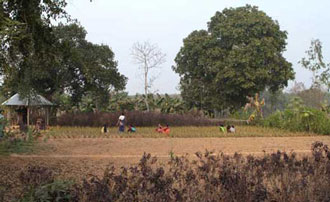
Organic farming supported by Marie Claire and Vivienne Westwood

Organic farming supported by Marie Claire and Vivienne Westwood

The project that Marie Claire and Vivienne Westwood are supporting is all about improving environment and economic conditions of communities in forest villages in Modhupur. Women (Garo and Koch) in particular will be involved in all project activities in sustainable and organic farming, which will also bring them income.

The project that Marie Claire and Vivienne Westwood are supporting is all about improving environment and economic conditions of communities in forest villages in Modhupur. Women (Garo and Koch) in particular will be involved in all project activities in sustainable and organic farming, which will also bring them income. Initially the organic faming practices remain limited to few villages, but gradually everyone, particularly Garo and Koch women living in Modhupur will benefit from the project activities. The forest is severely degraded and its ecological damages are alarming.

The Modhupur sal forest, the third largest forest patch in Bangladesh and home to matrilineal Garo indigenous community, has been thoroughly degraded. In its effort to create models for the protection of forests and sustainable agriculture, SEHD has been providing training in organic farming practices for the Garo women in Modhupur, teaching them how to organically cultivate medicinal plants and raise organic vegetable gardens and how to make a sustainable living from organic crops. It is also establishing a learning centre to educate everyone in the region about organic practices, indigenous culture, and the value of the natural forest.

The Garo women organized by SEHD under the umbrella of Simsaga (stay alert) are the managers of all project activities. The mother garden and nursery that SEHD has organized in Rajghati Village will be further strengthened and expanded so that it is able to supply enough seeds/seedlings and plants to all who want them.

Depending on the support, the maximum number of households possible will be provided with seeds, seedlings and cows (used for dung) to set up their organic garden of vegetables, medicinal plants and fruit trees. These households will play the role of catalysts in organic and sustainable agriculture and income generation through home gardening and by raising cows. They will be trained in savings in order to form a cooperative and help others in their villages. The operation will develop a model of sustainable agriculture and organic farming.

SEHD has already trained a group of villagers, especially women, in organic farming skills in order to develop nursery of saplings, to make naturally rich compost (pit compost, quick compost, green manure, vermi compost, and liquid manure), to set up a bio-gas plant, etc. The participants have also been introduced to different types of medicinal plants of commercial value that SEHD has been raising at its garden. With additional support, the training will be provided to women of as many forest villages as possible.

Women directly involved in organic farming will demonstrate their work to others and eventually become trainers for others in other in forest villages. They will also periodically organize exchange visits, meetings, and cultural programs to make organic farming popular in the area.

A community learning/knowledge centre, which will keep the participants of the project connected and anchored, will be formalized. A library will be set up within the centre for use of everyone in the locality. The knowledge developed by participating households will be documented in participatory method and made available for everyone else. The community centre will function as a meeting place for the villagers.

Impact of the project: The majority of the project beneficiaries are women who belong to the matriarchal Garo society. This has a particular significance. In Bangladeshi, women’s contribution in general is not recognized. Contrarily, in the Garo society, women have a strong voice, they are visible, and a role model to the rest of the country. They are the ones who can make a big difference in Modhupur. Their engagement in organic farming will improve the soil quality; make use of compost popular; make people aware of the adverse effects of excessive use of chemical pesticides, fertilizers and hormones; contribute in reducing the use of chemical fertilizers; make people aware of the significance of the natural forest patches and local species; and engage people in collecting polythene and plastic containers and dispose of them safely (a small action that will provoke larger thoughts).

Fire Accident at Garments Factory Kills 31

Fire Accident at Garments Factory Kills 31

In the latest fire accident on 14 December 2010 at a garments factory close to the capital Dhaka 31 workers got killed. The killed are all women and workers of Ha-Meem Group’s Sportswear Factory, located in Ashulia, an industrial zone just on the outskirts of the capital.

This major accident was preceded by another major fire accident on 25 February 2010 at Garib Sweater Factory in Gazipur (also close to Dhaka) killing 21 workers, 18 of them women.

The fire broke out during lunch time. The workers, panicked, ran helter-skelter to escape the flame; many jumped off different floors. The fire raged on the top three floors of the 11-storied factory building. The workers alleged that security guards closed four of seven exit staircases, a typical tactic that the guards resort to when fire accidents break out. The consequences prove fatal, leading to stampede and causing many to jump out of the building to escape the flames. The accident on 14 December was no exception in one of the biggest and supposedly well-managed factories.

For more information on previous fire accidents in the garments industry in Bangladesh and their casualties see the SEHD report.

Bangladesh: Most Densely Populated Country with 164.4 Million People

The population of Bangladesh has reached a staggering high stage, 164.4 million in a landmass of 147,570 sq. km or 56,977 sq. miles, the size of Iowa (IA) in the United States. There is no doubt this puts Bangladesh among the most densely populated countries in the world, with 2,885 people living per square mile (1114 per sq. km). This was disclosed in the UNFPA report “State of World Population 2010” in October 2010. The report also said the population growth is 1.4% per thousand.

The UNFPA exposé makes the Bangladesh Government unhappy as expressed by the director of planning commission Mr. Ganesh Chandra Sarker who contended the UNFPA figure and claimed that the current population of Bangladesh might be 140.4 million, which was 124.3 million in 2001 at the time of the last population census which takes place every 10 years.

However, the estimate of UNFPA matches with that of The Economist Intelligence Unit (EIU) Country report 2010 on Bangladesh. According to EIU the population of Bangladesh was 160.0 million in 2008. Its forecast of Bangladesh population was 162.2 million in 2009 and 164.9 million in 2010, which will be 167.5 million in 2011. The UNFPA forecasts Bangladesh population at 222.5 million by 2050.

Fire Accident at Garments Factory Kills 31

Extrajudicial killings in Bangladesh

Extrajudicial killings are a serious concern in Bangladesh. Police and the Rapid Action Battalion (RAB) allegedly kill people in their custody. Initially, RAB used the term “crossfire” to explain the circumstances of killings in its custody. It changed the terms to “shootout” or “encounter” in 2009. RAB, created in 2004 to serve as an elite anti-terrorism/crime force, is much-talked-about security agency for extra-judicial killings.

According to Ain O Shalish Kendra, a human rights organization, since RAB’s creation there has been 1,057 deaths under its custody (as of 2009). In 2004, 114 died in the hands of RAB, which rose to 320 in 2005. In 2006 the killed numbered 246; in 2007 it was 128; in 2008 it was 139; and in 2009 it was 110. Since early January 2009 when the Awami League Coalition government assumed office till September 2010, the persons facing extra-judicial killings stood at 200.

The High Court gave rulings on 17 November 2009 asking the government suo moto to explain the extrajudicial deaths. In the pretext of continued killings (11 illegal deaths since 17 November) the High Court passed and order on 14 December 2009 banning all such killings till the previous case was disposed of.

According to human rights watchdogs extrajudicial killing (of fatwas) still continue. According to human rights organization Odhikar that released a report on 1 October 2010, one extrajudicial killing took place in Bangladesh every three days since January to September 2010. Of the 90 victims during this period 40 were killed by RAB, 33 by police, 8 by the joint team of RAB and police, 5 by the RAB police-Coast Guard joint team, 3 by the RAB Coast Guard and one by the BDR. Ain O Shalish Kendra put the total figure at 95.