
Project to Protect Forest and Forest Peoples Kicked Off
The pressing issues and core concerns for the indigenous peoples and other forest-dependent peoples living in the forest regions of the Chittagong Hill Tracts (CHT) and the north-central districts of Tangail, Gazipur, and Mymensingh are centered around forests and land.The Society for Environment and Human Development (SEHD) has been working for more than three decades for the protection of forest and forest-dependent peoples. Cashing in on the valuable knowledge resources and experience on the issues concerning forest and forest people, SEHD has initiated a 42-month project from February 1, 2025 to study the current state of the forest, forest commons, condition of the communities living in the forest areas and to develop a roadmap for promotion of customary rights of the indigenous and forest-dependent people.
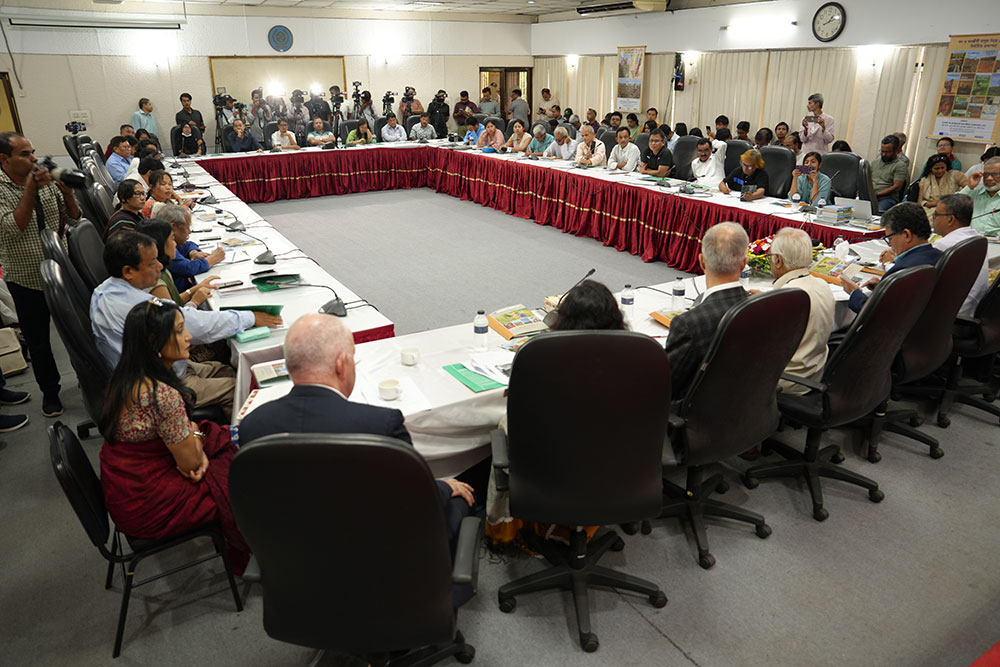
This project supported by the European Union and MISEREOR was officially kicked off on 20 July 2025 at CIRDAP in Dhaka. The purpose of the kick-off workshop was to share plan for research, investigations, and other activities to be conducted under the project with a broader audience. The event was attended by 140 people—25 from the Chittagong Hill Tracts (CHT); 30 fr0m Tangail, Mymensingh and Gazipur districts; and the rest from Dhaka. The participants from the CHT represented indigenous communities such as Chakma, Bawm, Khumi, Marma, Mro, Chak, Tripura, community-based organizations, traditional organizations, movements, non-governmental organizations, students and social workers. The participants from the north-centre represented indigenous peoples such as Garo, Koch, Barman and their organization.
The other participants and dignitaries included state functionaries such as the planning adviser of the interim government, two chief conservators of forests (CCFs)—one current and one former, some leading economists of the country, development and human rights actors, students and a large number of journalist (print and electronic).
In welcoming the guests and participants to the kick-off workshop, Prof. Tanzimuddin Khan, member of University Grants Commission (UGC), reflected on the historical perspective of destruction of forest and plights of the people who live in it. “Before British colonial rule, forests covered over 20 percent of the country’s land area; today, the cover is reduced to only 6 percent. Many conservation initiatives during this period drew inspiration from global models, notably the 18th-century establishment of Yosemite and Yellowstone National Parks in the United States, which introduced formal forest demarcation and the displacement of indigenous peoples,” recalled Prof. Khan.
“In a similar fashion, the British administration implemented a state-controlled ‘fortress conservation’ model, evicting ethnic and indigenous communities from their traditional forest lands. Later shifts to “Joint Forest Management” and “Co-Forest Management” incorporated limited local participation. Yet, despite these policy changes, forest governance has largely come at the cost of both biodiversity and the broader natural environment,” continued Prof. Khan.
Mr. Philip Gain, director of SEHD, presented the keynote paper and set the tone of the workshop. In his keynote he highlighted that prior to the British colonial rule, the forest-dwelling peoples of these two geographical areas lived in the forests without any trouble and freely collected necessary materials and food from the forest. However, the process of stripping them of their customary land rights began with enactment of Act Seven in 1865. Subsequently, development projects, introduction of plantation economy, militarization in the CHT, Bengali settlement in the forest, further expansion of reserved forest, and various other factors led to massive destruction of natural forest and rapid shrinking of customary rights over land and forest resources, rendering the lives and livelihoods of the IPs and other forest dependent peoples unprotected.
In recent history, development and plantation projects funded by multilateral development banks (MDBs) such as the Asian Development Bank and World Bank have further aggravated the situation. The 11 indigenous communities in the CHT and the Garo, Koch and Barman communities in the north-central districts of Tangail, Gazipur, and Mymensingh that have been living in the forest areas from time immemorial are badly impacted by severe degradation of forests and shrinking customary rights.
Mr Gain also noted that IPs and others living in the forest areas expected the interim government to play a meaningful role in protecting the forestland, the environment and the forest-dependent people. The task is challenging, but not impossible. “However, we have seen some actions of the Ministry of Environment, Forest and Climate Change as well as the forest department to restore natural forests in Modhupur and Gazipur sal forest areas. They have started to plant some sal saplings and seeds in the hope of bringing back sal forest in place of social forestry,” reported Mr. Gain in his keynote paper. “But there is sign that the interim government is doing anything for recognition of customary rights of the IPs and other people who live on forest land. The government’s move to restore natural forest thus may end up without much impact.”
The chief guest of the workshop, Prof. Wahiduddin Mahmud, an economist and planning adviser to the interim government shared his frustration over the overall state of the forests. He noted that two major problems exist as regards the forests—the first, the forest that should have been there does not exist; second, even the remaining forests are increasingly difficult to protect.
Speaking about the poverty among indigenous communities, Prof. Mahmud said, “A large portion of indigenous people (IPs) live in extreme poverty. But protecting the forests is not solely about safeguarding the livelihoods of IPs—it is more broadly about maintaining ecological balance. Forests are crucial for protection from various forms of disasters—natural and man-made.”
The adviser pointed out that the rights of the hill communities and other forest-dwelling groups are continuously shrinking. He observed that it is no longer viable for people to rely solely on existing forest resources for their livelihoods. The adviser admitted that foreign-funded projects have led to replacement of natural forests with exotic species of trees, causing significant forest degradation. He called upon the forest-dependent communities to rethink their relationship with forests. “Forests can be protected through planned and regulated resource extraction,” said the adviser. “Some say the forest laws need to be amended. I would say—please present us with a draft proposal. We will take action.”
The adviser believes that forest-dependent people themselves are best positioned to develop effective forest conservation strategies. In his remarks as a special guest, Mr. Michal Krejza, Head of Cooperation, Delegation of the European Union to Bangladesh, stressed the importance of civil society’s role in ‘advocating human rights, promoting transparency and accountability, and amplifying voices of the communities that often go unheard’. On support of the EU to SEHD, Mr. Krejza said, “We are delighted to support SEHD for the third time to empower indigenous peoples, other marginalized communities and their organizations.”
“I am very hopeful that the diverse participants from Chittagong Hill Tracts and North-centre will become active policy influencers and agents for change in the near future through this project,” said Mr. Krejza. “The farce in the name of forestry must be stopped at any cost,” said Miss Khushi Kabir, coordinator of Nijera Kori and Bangladesh Coordinator for One Billion Rising. “This government should review the forestry projects and identify the ones beneficial to the IPs and the ones that are simply for commercial purpose.”
She mentioned that data and information that this project will produce is going to be very crucial not only for the policymakers but also for the associates of this project and IPs in general in ensuring their rightful access to forests and traditional livelihoods. She requested SEHD to address two important and specific issues—conflict between Adivasi and Bengali settlers in the CHT and shrinking access of the IP women to forest resources.
Md. Amir Hossain Chowdhury, Chief Conservator of Forests (CCF), Forest Department, identified the excessive dependence of the people of Bangladesh on forests as the primary and foremost cause of deforestation in the country. Another contributing factor, he noted, is the prevailing model of ‘development economics.’
“In this densely populated and geographically small country,” the CCF said, “forestlands have always been the first to be cleared whenever land was needed for any purpose. There is a direct link between the current development paradigm and forest clearance.” He pointed out that natural forests in Bangladesh are often converted into commercial forests to meet the country’s timber demands. These demands include fuelwood, furniture, and raw materials for pulpwood industry.
According to the CCF, the Sundarbans is Bangladesh’s greatest pride. Satellite imagery from the past 20 years indicates that the Sundarbans has not undergone significant deforestation. In contrast, the highest rate of deforestation has occurred in the Chittagong Hill Tracts (CHT). The lack of effective forest management in that region has led to massive forest degradation.
Therefore, he stressed the necessity of a new kind of afforestation—one that balances the current needs of forest-dependent and forest-dwelling communities with the conservation of biodiversity. In parallel, he advocated for production-oriented forestry to meet the daily needs of citizens.
Md. Yunus Ali, a former CCF, stressed the demographic pressure on the limited resources in the CHT and pointed out how demographic structure has changed there over the decades. “Now there are more Bengalis than ethnic population in the CHT and they do not follow traditional agriculture there. This is a major reason for the increasing erosion on the slopes of the hills, particularly in the Unclassed State Forest,” said the former CCF.
He talked about a watershed management initiative in the reserved forests in the CHT to make sure the supply of quality water in the streams. “This initiative went into vain due to the loss of native trees as they were replaced by exotic species. Adivasis especially the women now suffer a lot as they need to go a long way to collect water for their domestic use,” observed Md. Ali.
Another distinguished guest at the event, Mr. Prashanta Tripura, country director of The Hunger Project and former university professor, emphasized the need to think globally, rather than merely locally, when it comes to forest conservation. He argued that forests must be protected not solely for the benefit of indigenous peoples, but for the entirety of humankind. “All living beings on this planet, including every human, depend on forests in one way or another,” he said. “In reality, no one truly lives in the forest in the literal sense. Even those we refer to as forest dwellers distinguish between forested areas and human settlements.”
He further observed that indigenous lifestyles are inherently inclined toward the preservation of nature. In contrast, modern, urban-centric societies are increasingly losing this ecological consciousness. He went on to say, “In Bangladesh, deep-seated inequalities persist and continue to reproduce themselves. Often, Bengalis fail to understand the pain of the hill peoples. Yet even within the hill communities, the Chakmas may overlook the struggles of the Tripuras, and when the Tripuras gain recognition of their rights, they may in turn forget the plight of the Mros or Khumis. We must break free from this cycle.”
Speaking on the issue of climate change, Mr. Prashanta Tripura remarked that while many nations and communities suffer its consequences, no single group bears sole responsibility. Climate change is the cumulative result of human activity across the globe, and therefore, the solution must also emerge from actions taken collectively, and contextually, in every corner of the world.
Dr. Hossain Zillur Rahman, chair and facilitator of the workshop emphasized the need to ensure justice through a multidimensional approach. “We must broaden our perspective. Justice is not unidimensional. I believe it has three distinct dimensions,” he stated.
In what he described as the Triangle of Justice, Dr. Rahman outlined the following three dimensions: (i) Community level—the stakeholders must understand and address the needs and struggles of the Indigenous Peoples (IPs) to ensure their rights. (ii) State level—authorities should critically evaluate state-run forestry projects to determine whether they serve the interests of the IPs. Policymakers must design more justice-integrated, indigenous community-centric forestry projects. and (iii) Citizen level—every individual must take responsibility for the global climate crisis and actively protect forests and the environment—not only for forest-dependent communities, but for all of the humanity.
Community Voice
Joya Tripura, CHT Women Headman Karbari Network
From my experience, I have seen that ever since the afforestation programs had begun in the Chittagong Hill Tracts, both forests and women have suffered. Indigenous women have a deep spiritual connection with the forest. It is they who must go into the forest every day to collect firewood and gather food. Men regard these tasks as the responsibility of women and are reluctant to venture into the forest for such work. When women are forced to travel to distant locations to collect firewood, they often face adversities.
Most indigenous women in the Chittagong Hill Tracts are heavily dependent on land. However, due to land encroachment, their rights have been severely compromised. Opportunities to collect wildly grown vegetables and other edibles from the forest have significantly diminished. Currently, women’s representation in social institutions is being impeded in different ways. We, the women of different ethnic communities in the Chittagong Hill Tracts, are still deprived of land rights and are subjected to military oppression. Although the number of female headman and karbari has increased compared to the past, they are not allowed to collect revenues and are they not properly compensated with honorariums for the time they devote. Mere increase in the number of women in these positions is not enough—they must be given meaningful roles and responsibilities. This requires a shift in perception from both men and women.
In a patriarchal society, women’s household labour is not recognized, and as a result, they are denied dignity. Women in the Chittagong Hill Tracts not only manage their households, they also take their produce to market for sale. In this context, I call upon the government to ensure our right to move about safely. The government policies and laws for the protection and advancement of women must be properly implemented. ZuamLian Amlai, chairperson, Bandarban Chapter, Movement for the Protection of Forest and Land in the Chittagong Hill Tracts
The dispossession of forest dwellers in the Chittagong Hill Tracts of their land forest began under British imperial rule and continues to this day. Successive governments have failed to address the fate of those living in state-declared reserved forests. The forests of the Chittagong Hill Tracts have been divided into two categories: Reserved Forest and Unclassed State Forest (USF). Later, in the 1960s, another category called Protected Forests was introduced. Over time, terms such as community forest, village forest, and Mouza forest have also emerged. Yet, the current condition of forests in the Chittagong Hill Tracts is extremely fragile. We do not know why the state repeatedly occupies forest land by giving it different names.
A pervasive culture of fear hangs over this land. Since Bangladesh’s independence, the Hill Tracts have been governed under an atmosphere of intimidation that silences dissent, particularly against certain state agencies. Even after the signing of the Chittagong Hill Tracts Accord in 1997, this climate has not changed. The July Movement of 2024 briefly raised hopes for change, but no positive transformation has followed.
Between 1990 and 1998, the government declared 88,367.94 acres across 43 mouzas of Bandarban as new reserved forest. Today, 140,000 acres have been permanently reserved through official gazettes across the CHT. In the past, it was possible to de-reserve forest land through the office of the Deputy Commissioner. Now, it cannot be done without the president’s approval. For ordinary people of the Chittagong Hill Tracts, reaching the president is practically impossible.
The Chittagong Hill Tracts Land Dispute Resolution Commission remains ineffective to this day and has not resolved a single land dispute. The people here call for urgent, time-appropriate reforms to the forest laws and for forest management that actively involves local communities. Through this gathering, we renew our appeal to the state to act.
Eugin Nokrek, president, Joyenshahi Adivasi Unnayan Parishad
Before the Partition of 1947, the Madhupur forest belonged to the Maharaja of Natore. Later, under the State Acquisition and Tenancy Act of 1950, enacted by the Government of Pakistan, it was stated that those residing within the forest could apply to the government for recognition of their rights. Unfortunately, since the forest dwellers of that time had little or no access to education and no notices ever reached them, they could not submit applications, and as a result, were denied land rights. Again, in 1956, when a similar legal provision was made, the indigenous inhabitants—being unaware of it—once more lost the opportunity to apply. In 1962, during another round of land survey, since no applications were submitted, the Madhupur forest was declared a reserved forest. From then onwards, eviction notices began to be issued to the communities living inside the forest.
I believe that certain misguided government decisions are linked to the destruction of the Madhupur forest. In particular, the so-called “social forestry” projects implemented on a partnership basis led to clearing of large tracts of natural forest in order to plant trees under social forestry. As a result, forestland has steadily diminished and the environment has been severely harmed. Legal provisions that enabled tree felling further accelerated the destruction of the forest. The government has now declared that no new social forestry projects will be undertaken in Madhupur. Our Madhupur forest is home to hundred of species of trees. There is no need to plant new trees; if the remaining natural plant species are preserved, the forest will naturally regenerate.
As recently as the 1970s, the Madhupur forest was home to wild boars, deer, porcupines, monkeys, and langurs. Now, only a few monkeys, foxes, and monitor lizards remain. Deer are so scarce that they are hardly ever seen. If natural sal forests that were once cut down and replaced with other species are replanted with sal again, the forestland will recover. Around 8,000 acres of forest were turned into rubber plantations, which turned out to be a completely unprofitable venture. Both indigenous people and Bengalis have possession of forestland. It is therefore urgent to demarcate the boundaries of our forest; otherwise, land grabbers will continue to encroach. Alongside this, I believe that the Forest Act of 1927 must be replaced with a new law that reflects the realities of the present time.
Alpana Sarker, General Secretary, Bangladesh Koch Indigenous Women’s Organization
I would like to present a few proposals for the protection of forests, forest-dependent communities, and indigenous peoples. First, instead of displacing indigenous peoples from forestlands, their customary rights over land and forests should be formally recognized. Indigenous peoples must be made priority partners in all afforestation initiatives in indigenous peoples-inhabited areas, so that they become stakeholders in forest conservation. Second, all exotic tree species should be completely removed and replaced with native species suited to the ecosystems of the hills and plains. In this process, the traditional knowledge and experience of indigenous peoples can be effectively utilized. Third, instead of evicting forest-dwelling indigenous and forest-dependent communities through false and harassing lawsuits, genuine landless residents of the forests must be rehabilitated. At the same time, hundreds of acres of forestland currently occupied by mills and factories established within forest areas must be reclaimed.
Women play the most vital role in forest protection, yet they remain invisible. In the past, indigenous women collected fuelwood and dug up wildly grown tubers from beneath the forest floor, which sustained the daily food needs of poor indigenous households. But now, these opportunities have drastically declined. Indigenous families have been excluded from government social foestry plots, which are instead controlled by influential elites. For indigenous women, the forest is not merely a source of resources—they revere it as a mother and care for it as they would their own children. A shining example of this is Sheli Chakma, who, through her women-led forest protection initiative, has planted more than 5,000 trees.
Open Forum
A open forum followed by the key session before lunch. The open forum was facilitated by Philip Gain. Mr. Bah Shing Thwai, a lawyer, highlighted how, after the suspension of land settlement, the government has been reserving forests since 1998 in CHT. As a result, forest-dependent people are losing their rights over the forest.
Process of reservation: Under Section 4 of the Forest Act, the government issues a preliminary notification in the official gazette declaring its intention to constitute a particular area as a reserved forest. The Forest Settlement Officer (FSO) invites claim from local people and communities who may have rights over the land—such as grazing, collecting firewood, or cultivating. After investigation, the FSO may admit and record the rights, modify them or extinguish them by providing compensation. Once the claims are settled, the government issues a final notification under Section 20 of the Act and land officially becomes a reserved forest. In between sections 4 and 20 other sections are followed according to forest legislations.
Ms. Han Han, a development worker pointed out the consequences of natural resource extraction, used in infrastructural development in cities and road construction, on the lives of forest dependent people. She cited some examples. First, the extraction of topsoil is leading to soil infertility, resulting in decrease in harvests and an increased risk of landslides. Second, stone extraction from the CHT is drying up the streams leading to water crisis in the hills. The same type of extraction in Jaflong has been banned but that has not happened in the case of CHT yet even though the quality of these stones is not up to the mark. Third, disposal of urban wastes in rivers and streams in Bandarban. She stressed the importance of formulating a master plan for this kind of extraction, which will include measures to protect the rights of forest dependent people to forest resources. “This master plan must also include a strategic and ecofriendly management plan for tourism in the CHT regions,” she recommended.
Ms. Tanzina Dilshad, programme manager, Delegation of the European Union to Bangladesh, talked about the value of the project in highlighting the issues of the forest, IPs and others living in forest areas. She also mentioned that the project implemented by SEHD is small but is a high priority to the European Union.
Mr. Ajoy A. Mree, chairman of Adivasi Cultural Development Forum based in Modhupur reflected of the appalling condition of the forest and difficulties that the peoples of the forest villages are facing.
Report by Syeda Amirun Nuzhat, Fahmida Afroze Nadia, Fahmida Rahman and Jidit Chakma with Philip Gain | PDF