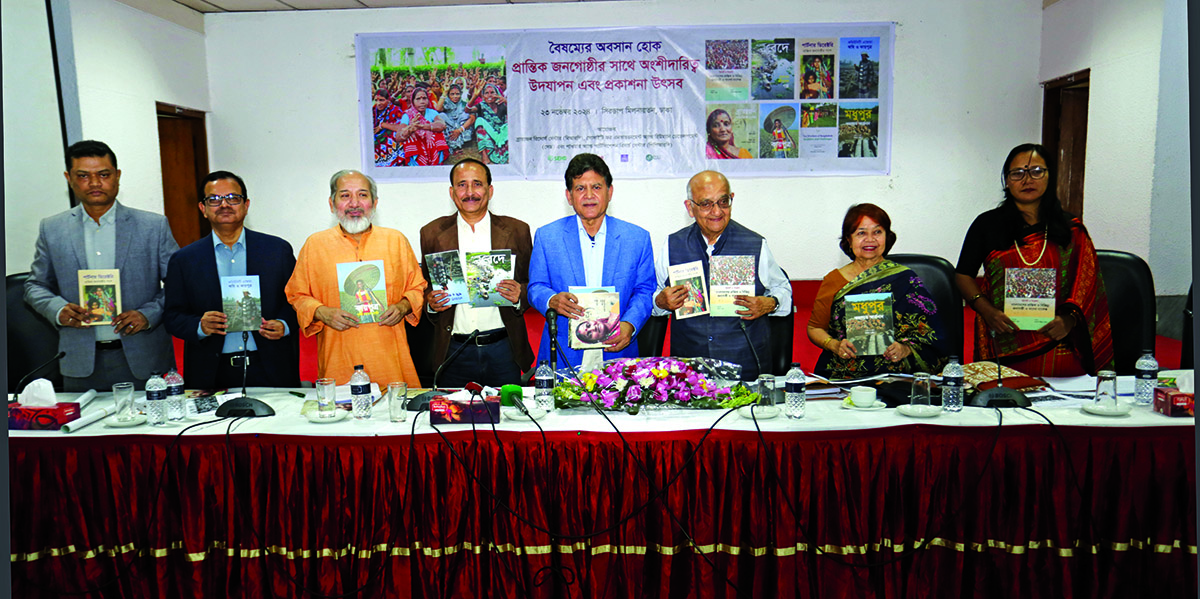
The dignitaries are showing the books launched at a national workshop. (from lfet) Barrister Jyotirmoy Barua, Prof. Zakir Hossain Raju, Prof. Syed M Hashemi, Philip Gain, Dr. Hossain Zillur Rahman, Prof. Rehman Sobhan (chief guest), Prof. Rounaq Jahan, and Joya Tripura. Photo: Prosad Sarker.
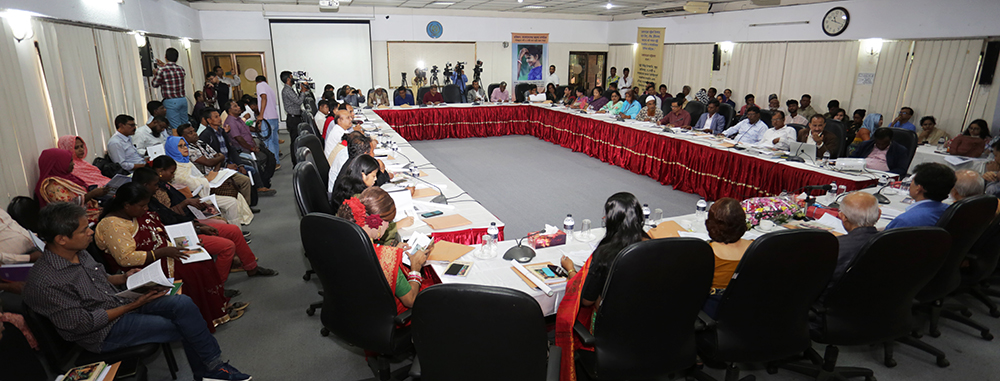
A strong message aired at the event was that discrimination should end in all forms. At least 130 representatives from all ten beneficiary groups of BRC, human rights defenders, community-based organizations, civil society organizations, economists, trade union leaders, academia, and journalists joined the day-long event.
The organizers of the event welcomed the audience with a message that communities with different vulnerabilities should not be seen as victims. They have many potentials, strengths, diverse cultures and languages.
In his welcome note, Prof. Zakir Hossain Raju, head of the department of Media and Communication, Independent University, Bangladesh, and Executive Committee member, SEHD shared his concerns over the exclusion of marginalized people at the policy-level discussions. “The presence of marginalized communities is not seen with apt attention in the policy-making sphere in Bangladesh,” said Prof. Raju. Quoting from Gayatri Chakravorty Spivak’s original essay ‘Can the Subaltern Speak?’ he observed that there is no place for the subalterns or the lower-class population to express their opinions.
With the change of the regime in August 2024, he expressed his wish to see a pluralistic society free from all discrimination. “We are hopeful of positive reforms. At the same time, we must also strengthen our partnership with these communities,” noted Prof. Raju.
In keynote address, Mr. Philip Gain, director of SEHD explained the background of BRC, its goal and mission, and how the communities it is devoted to—Adivasis (ethnic communities), tea workers (80 ethnic communities), sex workers, transgender, Bede, Harijan, Rishi, Kaiputra, Jaladas and Bihari—are its bona fide beneficiaries.
“All citizens of the country are equal, and no one can be discriminated based on identity or occupation or anything. Such a desire has been in people’s minds for a long time, which was expressed through the July uprising,” noted Mr. Gain. “Now we have got an interim government. We expect that this government will make every effort to build a Bangladesh free from discrimination as far as possible. Hopefully, they will come up with the right roadmap.”
Mr. Gain discussed the findings of the books launched in this context. Considering those findings, he proposed some areas of reform—protection of the identity, language and culture of these communities; reform in wage structure; proper implementation and monitoring of labour legislation; reforms in the tea industry; equal opportunities and positive discrimination for select communities; ensuring social security and justice; distribution of khas land among the landless marginalized and poor people; implementation of the peace accord in the CHT; implementation of international conventions and ending legal discrimination; and protection of the environment, forest and forest dwellers.
Special guest Prof. Rounaq Jahan, distinguished fellow, Centre for Policy Dialogue (CPD), gracefully shared her thoughts after listening to the community voices. Observations from communities astonished her. “If I did not come here, I would never know that amendments in legislation can be a matter of worry for some communities,” she noted.
Stressing the inclusion of community representatives to the reform commission, she said, “Now is the time to think about how to connect these communities with the interim government. Organizations like SEHD, PPRC, and CPD can play a leading role in this regard.”
She also stressed the importance of generating proper statistical data on these marginalized population and figuring out a way to best preserve the diversity of these communities while ensuring equal respect and dignity for them.
Another special guest, Prof. Syed M Hashemi, BRAC University, delivered that “living a dignified life is more important than economic rights.”
“You must make your voice louder. Otherwise, change will never happen,” said Prof. Hashemi. “Discussions are being held in narrow circles. We have to spread it around. If we cannot put pressure unitedly, all our efforts will go in vain.”
Barrister Jyotirmoy Barua, a lawyer of Supreme Court of Bangladesh reflected on legal issues relating to the rights of the marginalized communities. “According to the official report there are a good amount of khas (public) land unutilized. The government has an ample ground to distribute such land among marginalized and landless communities,” said Barrister Barua.
He also highlighted the constitutional rights of the transgender community, Biharis, and ethnic minorities. On misuse of the constitution in restricting the use of the term ‘Adivasi’ he said, “The function of the constitution is to ensure rights, not to define identity. This identity politics needs to be stopped.”
Barrister Barua strongly urged the government to sign the ‘Indigenous and Tribal Peoples Convention, 1989’ which ensures fundamental human rights of these population as well as protect their identities, languages and religions within the framework of the states they live in.
Article 14 of ‘Indigenous and Tribal Peoples Convention, 1989’ says,
“The rights of ownership and possession of the peoples concerned over the lands which they traditionally occupy shall be recognised. In addition, measures shall be taken in appropriate cases to safeguard the right of the peoples concerned to use lands not exclusively occupied by them, but to which they have traditionally had access for their subsistence and traditional activities.”
“Particular attention shall be paid to the situation of nomadic peoples and shifting cultivators in this respect.”
“Governments shall take steps as necessary to identify the lands which the peoples concerned traditionally occupy, and to guarantee effective protection of their rights of ownership and possession.”
“Adequate procedures shall be established within the national legal system to resolve land claims by the peoples concerned.”
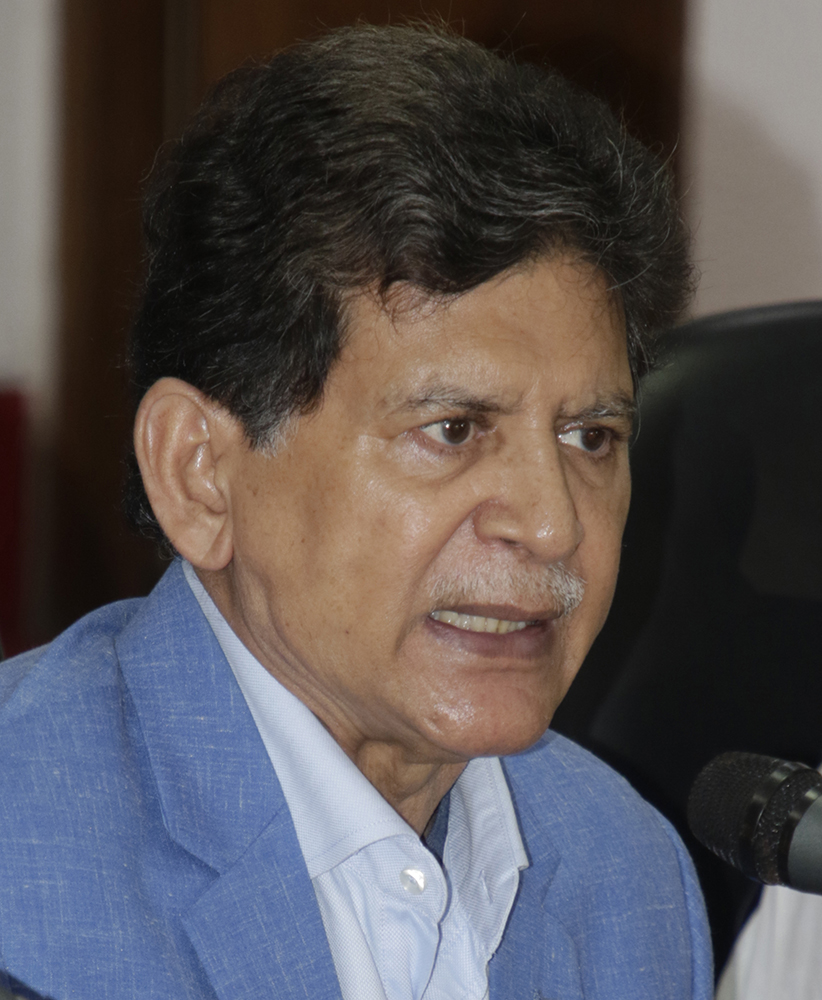
Prof. Rehman Sobhan, an eminent economist and chief guest at the event shared from his lifelong work experience of economic development, frustration and pathway for progress of the people economically downtrodden and left behind. A teacher of economics of Prof. Yunus who is now heading the interim government, Prof. Rehman Sobhan hoped “Professor Yunus will do the right thing.”
On miseries of tea workers, he said, “I have been hearing about their problems since 1960. It seems with time passing new dimensions are getting added to their already existing problems.” To bring economic relief to the tea workers he suggested, “Give them a share in the tea gardens and land they live on and till, no matter how small it is. This will give them an entitlement and effectively contribute to their economic upliftment.”
He proposed some probable solutions to the problems of marginalized population. He suggested a ‘basic income’ for all people including the marginalized groups who are in need of help to migrate out of destitution. “It will help to lead a decent life of the destitute people,” said Prof. Sobhan. “This is a national solution that I am proposing.”
Finally, he urged the community representatives, “You may approach Prof. Yunus to form a separate reform commission for you. Even if the interim government does not form a separate commission for you, the road does not end here. You can form a civic platform and share your demands. Hope the Chief Adviser will take note of that.”
In summarizing the discussions, Dr. Hossain Zillur Rahman, chair of event and facilitator concluded that the condition of the marginalized and excluded communities needs to be changed at three levels which are interconnected and should be followed to end discrimination. In the first level, their struggles should become visible through research and analysis. At the second level community voices should get louder and heard. Then their active participation in the policy making process has to be ensured.
“To bring economic relief to the tea workers give them a share in the tea gardens and land they live on and till, no matter how small it is. This will give them an entitlement and effectively contribute to their economic upliftment.”
—Prof. Rehman Sobhan
-
Prof. Rehman Sobhan
-
Prof. Rounaq Jahan
-
Dr. Hossain Zillur Rahman
-
Mr. Rambhajan Kairi
Community Voices
Five community representatives spoke in the first session. They all are defenders of rights and active in their respective communities. They all shared their personal and community experiences.
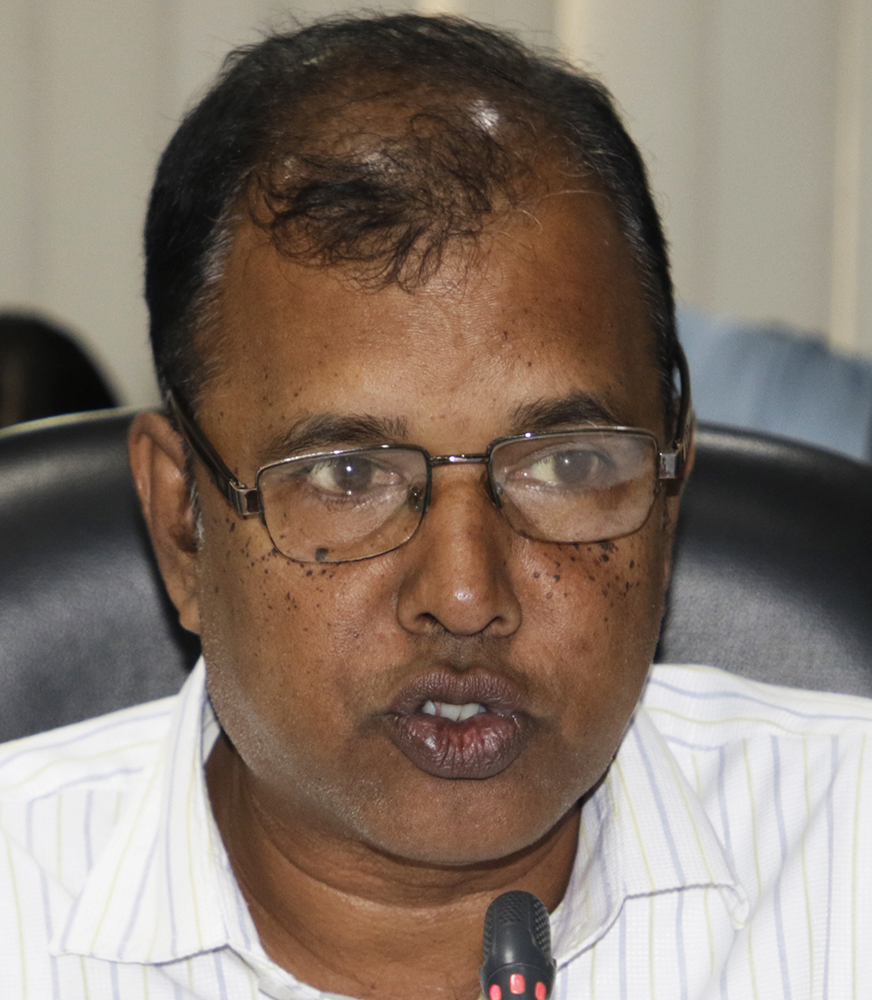
Rambhajan Kairi, former general secretary, Bangladesh Cha Sramik Union (BCSU)
Several discriminations in the labour legislation are concerning for tea workers. We get worried every time we hear about an amendment is made to the labour law. Tea workers are not entitled to casual leave like in other industries. Gratuity was scrapped for us in the amendment of 2018. My question is, whose purpose do these amendments serve? They do not necessarily serve us. We have serious trouble with election of BCSU, the lone trade union in the tea industry and the largest in the country. The two-year labour agreement between the owners’ apex body Bangladesh Tea Association (BTA) and BCSU depends on the owner’s wish. The agreement is always signed post-facto. On the other hand, the last election of BCSU was held in 2018. As a result, the union is getting weaker and owners are taking advantage of it. One of our key concerns is low wages. We hope the interim government pays attention to the tea workers reforming the existing minimum wage structure considering the current market prices.
Eugin Nokrek, president of Joyenshahi Adibashi Unnayan Parishad
Social forestry projects have been destroying natural forest in Modhupur. Biodiversity has been massively destroyed in sal forest. We can no more collect wildly grown vegetables and herbs from the forests.
Our main problem relates to land rights. Most of us living in the forest villages do not have title deeds for land we live on and cultivate. As a result, we are always in fear of eviction. In Modhupur, we need low-interest loans, which we do not get from banks. As a result, many of us do not cultivate our land ourselves; we lease them to Bengalis. We also demand quota for the first- and second-class government jobs for the Adivasi communities.
Joya Tripura, president, CHT Women Headman-Karbari Network
The main problem in the CHT relates to land. We, indigenous women in the Chittagong Hill Tracts, are worst affected for rapidly shrinking of our traditional agriculture—jum cultivation. Factors such as development projects; plantation of timber trees, rubber, and tobacco; and Bengali settlement have led drastic loss of land available for jum cultivation. The land commission set up after the 1997 CHT Accord to settle land disputes remains non-functional to date. Yet, we are optimistic and we hope that the interim government will include representative from the CHT in the reform commission.
Milan Das, executive director, PARITTRAN
I represent Rishi community. Our existence in this world feels like a curse. When I was in the 5th grade in school, I used to get singara served on a paper at the market next to our school where my friends used to have it on plate. Even today, 30 years later, that discrimination continues.
We are shocked that after July-August uprising that toppled the government of Sheikh Hasina, Hindus came under attacks. Seventy-seven 0f our Rishi students actively took part in the movement at Dhaka University. They were not affiliated with any party. Yet, they were attacked after 5 August 2024.
We demand social recognition and equal dignity as others in society. The interim government should accommodate us in each of the 10 reform commissions to consider our needs.
-
Prof. Syed M Hashemi
-
Jyotirmoy Barua
-
Prof. Zakir Hossain Raju
-
Syed Sultan Uddin Ahmed
Krishnalal, president, Bangladesh Horijon Yokkha Parishad
We are bound to become cleaners generation after generation. My father was a cleaner, I am a cleaner and my children are cleaners. We are as if born to live with garbage. Even though we are educated, we do not get right jobs, because we are Harijans and untouchables.
We are frustrated, because despite raising our voices for the last 23 years and holding seminars and discussions, difficulties we face at work and in society have not been solved. Nobody listens to us because there is no political agenda.
Open Forum
In an open forum in the afternoon chaired by Syed Sultan Uddin Ahmed, executive director, Bangladesh Institute of Labour Studies (BILS) and facilitated by Philip Gain, more community representatives shared their thoughts for formulation of a draft reform agenda for the marginalized and excluded communities. Seven community leaders spoke on the community demands and solutions. The topmost of their demands and solutions were related to land, fair and equal income, legitimate rights of the tea workers, social recognition, social security, standard education, etc.
Mr. Nripen Paul, acting general secretary of Bangladesh Cha Sramik Union (BCSU) spoke on tea workers’ right to land, discrimination in the labour law for tea workers and violation of its important sections. He cited two examples—the tea workers getting no casual leave and gratuity—to explain how the tea workers are discriminated. He mentioned a current concern—12 gardens of the National Tea Company (NTC) not paying wages to tea workers for weeks. He demanded that the interim government steps in to solve the issue.
Aleya Akhter Lily, president, Sex Workers’ Network (SWN) stressed on the recognition of sex work as a profession. She said many workers undergo torture. “Recently, 1,300 sex workers have been subjected to torture,” reported Ms. Lily. “Children of sex workers are not given jobs because of their mother’s identity. We want this discrimination to end. We want social security and development-oriented programs.”
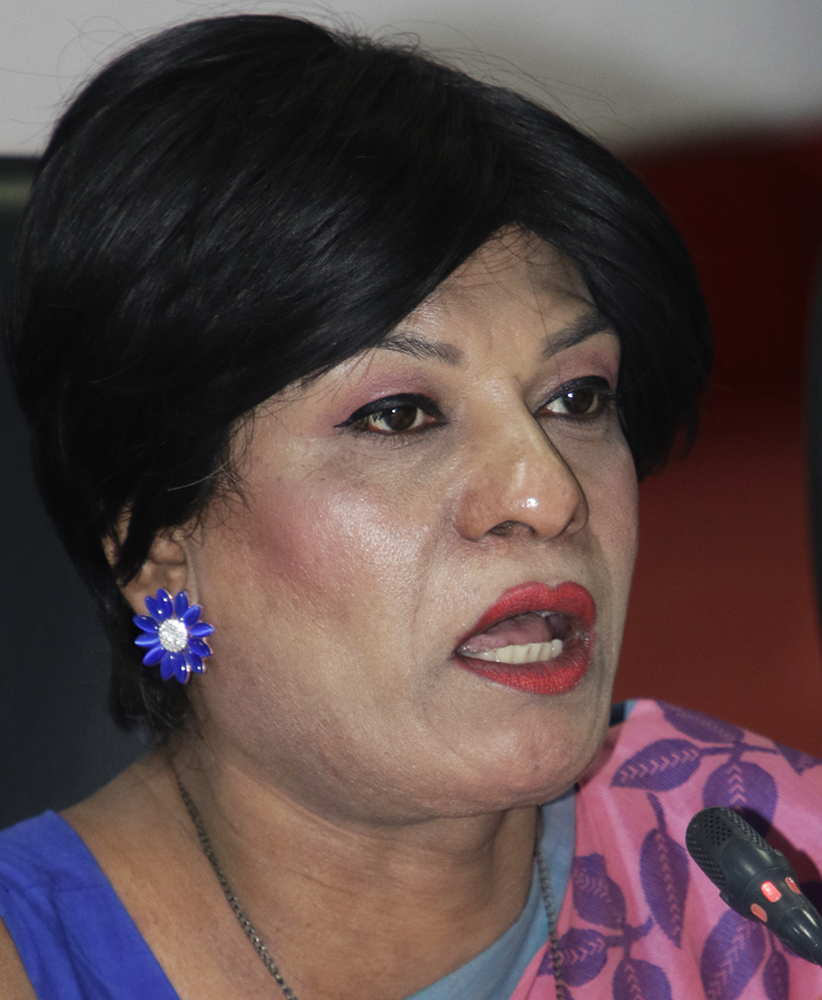
Speaking of her community’s acceptance in society, Joya Sikder, a transgender activist, questioned, “Why cannot our society accept our identity when different countries of the world can? How are we supposed to achieve SDG 5 without it?” She stressed, “If society, family, and state accepted us with due dignity and respect, everyone could live happily. For this, we need to stand together,” she further stressed.
Mortuza Ahmed Khan, Bihari representative from Geneva Camp, Dhaka said in grief, “We are enormously deprived of basic human rights. After 1971, we had been treated inhumanely.” He stressed on the need of mapping of the Bihari camps, and estimating the Bihari population size. “The Biharis often time face eviction threat,” said Mr. Khan. “We really do not want to live in camps. What we want is respectful rehabilitation.”
-
Ms. Joya Tripura
-
Mr. Nripen Paul
-
Joy Sikder
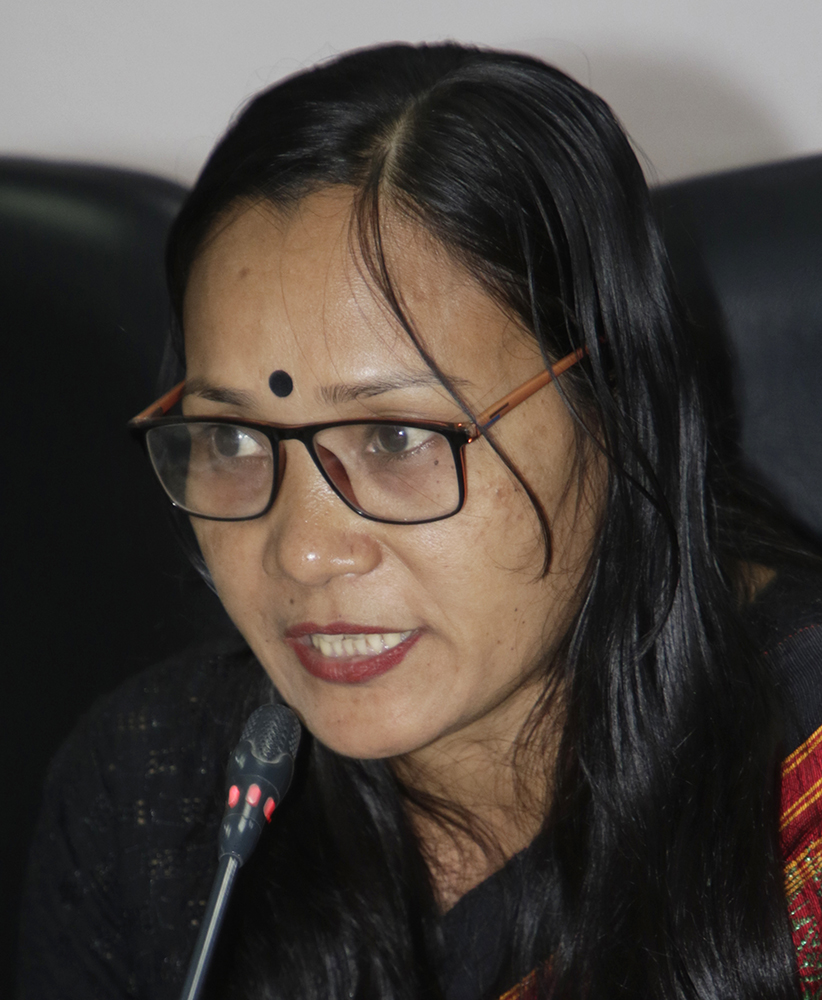
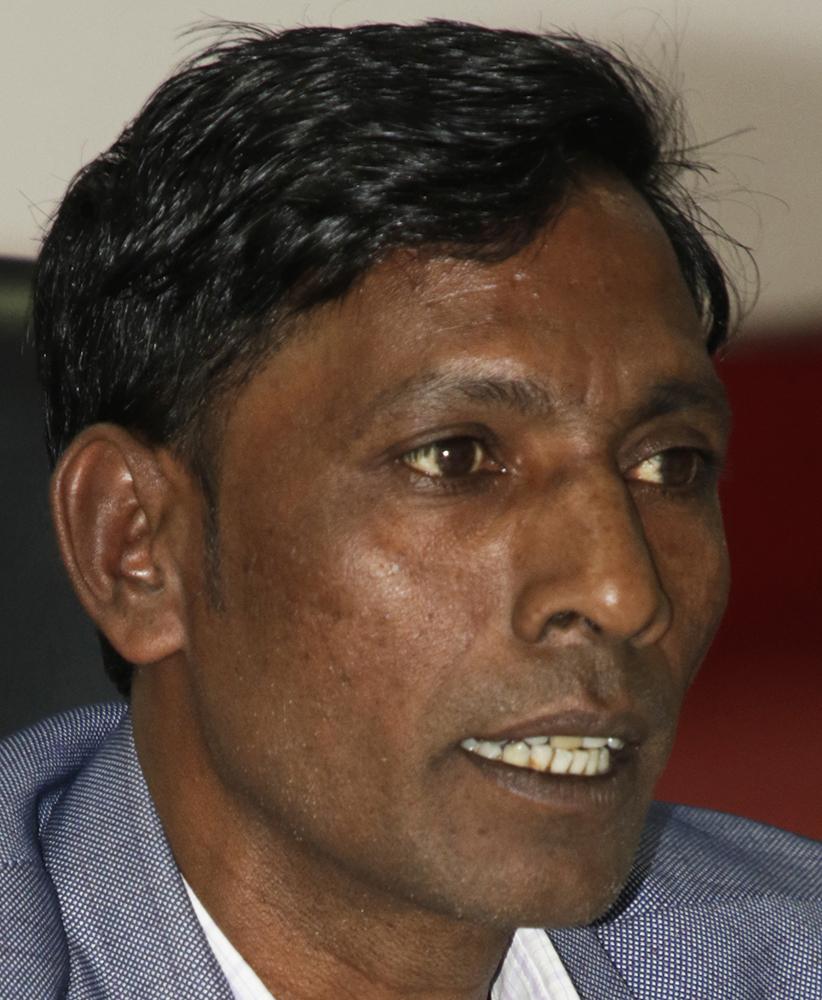
Liton Das, president, Uttar Chattola Upokuliya Motshojibi Jaladas Samabay Kalyan Federation in Chattogram talked about the plights of the Jaladas, a sea-faring Hindu fishing community, concentrated in Chattogram and Cox’s Bazar. “We, Jaladas, are suffering heavily from economic crisis. We do not get bank loans and without other options left, we are compelled to take loans (dadon) from local businessmen at very high interest rates,” said Mr. Das. He stressed on scaling up social security for the Jaladas community and said, “Government should ensure adequate benefits for widows and healthcare facilities for women.”
Modon Kumar Mondol, a representative of Kaiputra, a pig rearing community concentrated in Satkhira, Jashore and Khulna districts, raised the insurmountable difficulties his community faces. “The majority of Bangladesh do not know who we are and the terrible time we go through in our trade with pigs,” said Mr. Mondol. “We should be able to access bank loans.”
Hridoy Harijan, a Harijan youth from Dhaka, said, “We want complete elimination of wage inequality among Harijan cleaners and between Bangali and Harijan cleaners.” He also demanded employment based on merit and secured housing, healthcare facilities, and risk allowances for cleaners and their families.